
What you will take away
- The comparison counts all 1,520 offered question positions, including optional Section B in 2021–2024.
- Statements, assertion–reason and matching are separate formats; chapter weightage is a separate concept classification.
- Choose a year and subject to inspect counts, percentages and the exact questions behind each chapter.
Start here if: Know the chapter concept; this guide helps you read its question format and compare historical counts.
Jump to a section
Start with an identified paper
A useful trend needs a defined paper, not a floating total. This audit reads one identified English booklet for each year from 2019 to 2026 and records each question’s format, primary chapter and PDF page. Every displayed count comes from that ledger.
The 2026 row uses the 21 June re-examination. The cancelled 3 May paper is excluded, as are separate regional or special re-tests in other years. The older optional-section papers retain all 200 offered questions, so their counts are not relabelled as a candidate’s chosen 180.
Inspect the eight source booklets and their provenance →
Question-by-question audit · 2019–2026
Three formats. Eight identified papers.
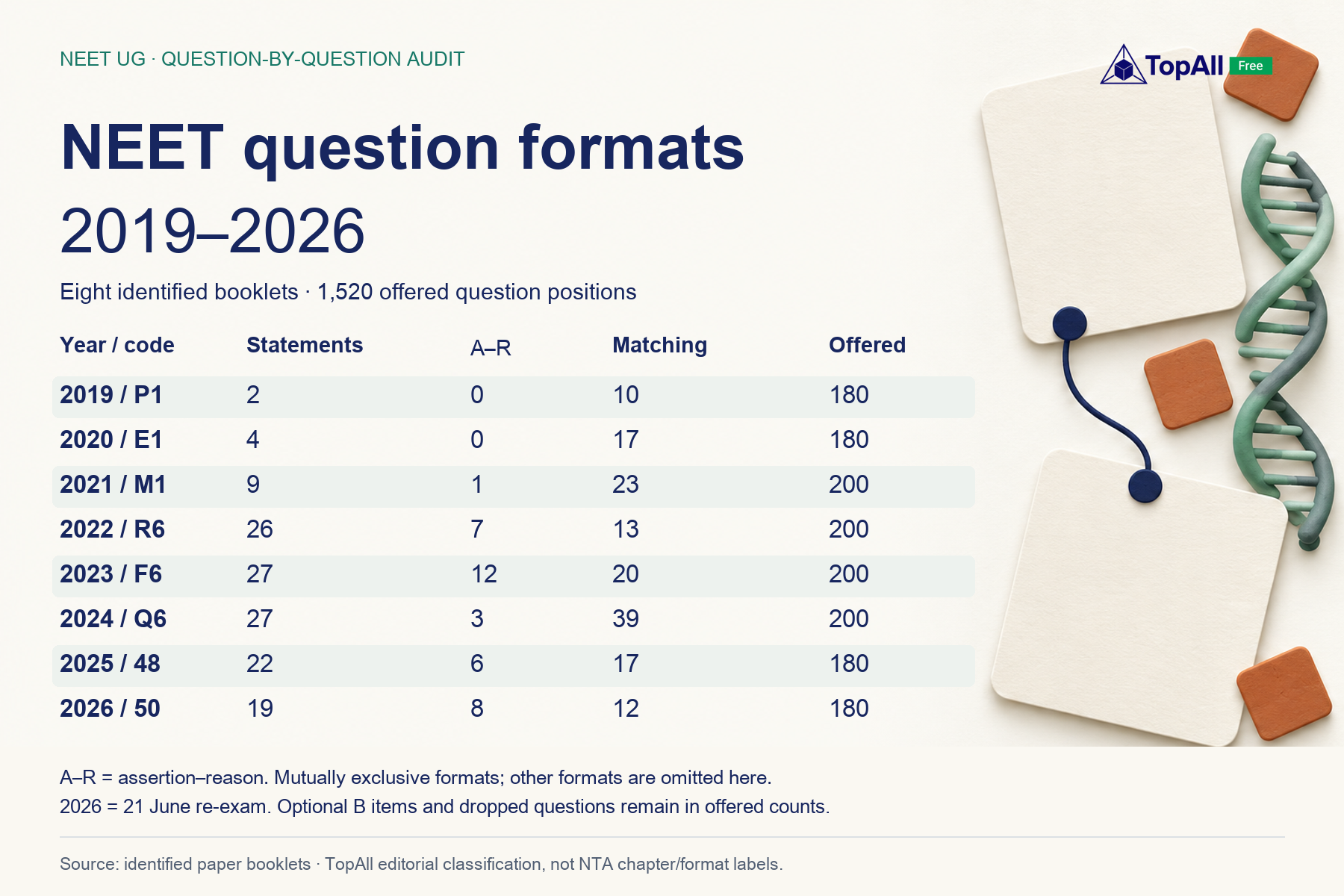
1,520 offered question positions, classified from paper content. Statements, assertion–reason and matching remain separate.
Questions · shared zero-based scale 0–50
Combined share = (statements + assertion–reason + matching) ÷ all offered questions. Scroll tables horizontally on smaller screens.
| Year / code | Statements | Assertion–reason | Matching | Other | Offered | Combined / offered |
|---|---|---|---|---|---|---|
| 2019 / P1 | 2 | 0 | 10 | 168 | 180 | 6.7% |
| 2020 / E1 | 4 | 0 | 17 | 159 | 180 | 11.7% |
| 2021 / M1 | 9 | 1 | 23 | 167 | 200 | 16.5% |
| 2022 / R6 | 26 | 7 | 13 | 154 | 200 | 23% |
| 2023 / F6 | 27 | 12 | 20 | 141 | 200 | 29.5% |
| 2024 / Q6 | 27 | 3 | 39 | 131 | 200 | 34.5% |
| 2025 / 48 | 22 | 6 | 17 | 135 | 180 | 25% |
| 2026 / 50 | 19 | 8 | 12 | 141 | 180 | 21.7% |
TopAll editorial classification, not NTA statistics. Statement sets contain explicit claims; their subject may be supplied by the stem. Ordinary single-correct statement options, sequencing and nominal species/event/reaction selections are other. Each question gets one format and one primary chapter. Secondary chapters do not add to totals. Classification is interpretive; it is not an external subject-expert certification.
Comparable base: 2019/2020/2025/2026 use 180 offered questions; 2021–2024 use 200, including optional Section B. Counts include every offered item, even a subsequently dropped question. The 2026 row is 21 June; the cancelled 3 May paper and regional/special re-tests are excluded. No missing years have been interpolated.
Inspect subject counts for every year
2019: subject breakdown · 180 questions offered
| Subject | Statements | Assertion–reason | Matching | Other | Offered |
|---|---|---|---|---|---|
| Physics | 0 | 0 | 0 | 45 | 45 |
| Chemistry | 0 | 0 | 2 | 43 | 45 |
| Biology | 2 | 0 | 8 | 80 | 90 |
2020: subject breakdown · 180 questions offered
| Subject | Statements | Assertion–reason | Matching | Other | Offered |
|---|---|---|---|---|---|
| Physics | 0 | 0 | 0 | 45 | 45 |
| Chemistry | 2 | 0 | 2 | 41 | 45 |
| Biology | 2 | 0 | 15 | 73 | 90 |
2021: subject breakdown · 200 questions offered
| Subject | Statements | Assertion–reason | Matching | Other | Offered |
|---|---|---|---|---|---|
| Physics | 1 | 0 | 2 | 47 | 50 |
| Chemistry | 2 | 0 | 4 | 44 | 50 |
| Biology | 6 | 1 | 17 | 76 | 100 |
2022: subject breakdown · 200 questions offered
| Subject | Statements | Assertion–reason | Matching | Other | Offered |
|---|---|---|---|---|---|
| Physics | 1 | 1 | 2 | 46 | 50 |
| Chemistry | 6 | 2 | 5 | 37 | 50 |
| Biology | 19 | 4 | 6 | 71 | 100 |
2023: subject breakdown · 200 questions offered
| Subject | Statements | Assertion–reason | Matching | Other | Offered |
|---|---|---|---|---|---|
| Physics | 2 | 0 | 0 | 48 | 50 |
| Chemistry | 5 | 4 | 2 | 39 | 50 |
| Biology | 20 | 8 | 18 | 54 | 100 |
2024: subject breakdown · 200 questions offered
| Subject | Statements | Assertion–reason | Matching | Other | Offered |
|---|---|---|---|---|---|
| Physics | 5 | 1 | 2 | 42 | 50 |
| Chemistry | 5 | 0 | 7 | 38 | 50 |
| Biology | 17 | 2 | 30 | 51 | 100 |
2025: subject breakdown · 180 questions offered
| Subject | Statements | Assertion–reason | Matching | Other | Offered |
|---|---|---|---|---|---|
| Physics | 0 | 0 | 0 | 45 | 45 |
| Chemistry | 7 | 1 | 6 | 31 | 45 |
| Biology | 15 | 5 | 11 | 59 | 90 |
2026: subject breakdown · 180 questions offered
| Subject | Statements | Assertion–reason | Matching | Other | Offered |
|---|---|---|---|---|---|
| Physics | 0 | 0 | 1 | 44 | 45 |
| Chemistry | 5 | 3 | 2 | 35 | 45 |
| Biology | 14 | 5 | 9 | 62 | 90 |
Follow each count back to the paper
Chapter-wise weightages
2026 · Biology · booklet 50
Share of subject = chapter questions ÷ offered Biology questions. Share of paper = chapter questions ÷ all offered questions. These are question shares, not obtainable-mark shares. For optional sections, a candidate’s chosen 180 questions can have different shares.
Historical NCERT chapter groups keep older content visible; p-block is consolidated across XI/XII. Zero means no primary item assigned, not that a topic was in the syllabus or should be skipped. Cross-topic choices are explained in the question ledger.
2026 key adjustment: code 50 Q26 was dropped; Q38 accepts 2 and 3. Both remain in this offered-paper content audit. Non-dropped item count is 179. The final key does not supply chapter or format tags.
| Primary chapter | Questions | % of subject | % of paper | Statements | A–R | Matching | Question references |
|---|---|---|---|---|---|---|---|
| Cell: The Unit of Life | 7 | 7.78% | 3.89% | 1 | 0 | 1 | Q93 (p25), Q94 (p25), Q96 (p26), Q97 (p26), Q98 (p26), Q108 (p28), Q123 (p32) |
| Evolution | 6 | 6.67% | 3.33% | 1 | 1 | 0 | Q141 (p35), Q147 (p37), Q159 (p39), Q160 (p39), Q164 (p40), Q170 (p41) |
| Biological Classification | 5 | 5.56% | 2.78% | 0 | 0 | 2 | Q92 (p25), Q101 (p27), Q112 (p29), Q126 (p32), Q129 (p33) |
| Locomotion and Movement | 5 | 5.56% | 2.78% | 0 | 0 | 0 | Q91 (p25), Q104 (p27), Q140 (p35), Q152 (p37), Q158 (p38) |
| Photosynthesis in Higher Plants | 5 | 5.56% | 2.78% | 1 | 0 | 0 | Q100 (p27), Q102 (p27), Q114 (p30), Q116 (p30), Q122 (p32) |
| Biotechnology: Principles and Processes | 4 | 4.44% | 2.22% | 1 | 1 | 1 | Q162 (p39), Q168 (p40), Q176 (p42), Q180 (p43) |
| Human Health and Disease | 4 | 4.44% | 2.22% | 0 | 0 | 0 | Q165 (p40), Q171 (p41), Q177 (p42), Q179 (p43) |
| Human Reproduction | 4 | 4.44% | 2.22% | 1 | 0 | 0 | Q143 (p36), Q145 (p36), Q166 (p40), Q173 (p41) |
| Organisms and Populations | 4 | 4.44% | 2.22% | 0 | 2 | 1 | Q161 (p39), Q163 (p39), Q172 (p41), Q174 (p41) |
| Sexual Reproduction in Flowering Plants | 4 | 4.44% | 2.22% | 0 | 0 | 0 | Q151 (p37), Q154 (p38), Q155 (p38), Q156 (p38) |
| Animal Kingdom | 3 | 3.33% | 1.67% | 2 | 0 | 0 | Q107 (p28), Q130 (p33), Q132 (p34) |
| Body Fluids and Circulation | 3 | 3.33% | 1.67% | 0 | 0 | 0 | Q115 (p30), Q117 (p30), Q149 (p37) |
| Chemical Coordination and Integration | 3 | 3.33% | 1.67% | 1 | 0 | 1 | Q99 (p26), Q124 (p32), Q148 (p37) |
| Morphology of Flowering Plants | 3 | 3.33% | 1.67% | 1 | 0 | 1 | Q105 (p27), Q113 (p29), Q120 (p31) |
| Plant Growth and Development | 3 | 3.33% | 1.67% | 0 | 0 | 0 | Q110 (p29), Q127 (p33), Q133 (p34) |
| Principles of Inheritance and Variation | 3 | 3.33% | 1.67% | 1 | 1 | 0 | Q138 (p35), Q169 (p40), Q175 (p42) |
| The Living World | 3 | 3.33% | 1.67% | 0 | 0 | 1 | Q118 (p30), Q119 (p31), Q125 (p32) |
| Biomolecules | 2 | 2.22% | 1.11% | 0 | 0 | 1 | Q106 (p28), Q134 (p34) |
| Cell Cycle and Cell Division | 2 | 2.22% | 1.11% | 1 | 0 | 0 | Q128 (p33), Q131 (p34) |
| Ecosystem | 2 | 2.22% | 1.11% | 1 | 0 | 0 | Q146 (p36), Q178 (p42) |
| Molecular Basis of Inheritance | 2 | 2.22% | 1.11% | 0 | 0 | 0 | Q153 (p38), Q167 (p40) |
| Plant Kingdom | 2 | 2.22% | 1.11% | 1 | 0 | 0 | Q111 (p29), Q121 (p31) |
| Reproductive Health | 2 | 2.22% | 1.11% | 0 | 0 | 0 | Q139 (p35), Q142 (p36) |
| Structural Organisation in Animals | 2 | 2.22% | 1.11% | 0 | 0 | 0 | Q103 (p27), Q135 (p34) |
| Biodiversity and Conservation | 1 | 1.11% | 0.56% | 0 | 0 | 0 | Q144 (p36) |
| Biotechnology and its Applications | 1 | 1.11% | 0.56% | 0 | 0 | 0 | Q137 (p35) |
| Breathing and Exchange of Gases | 1 | 1.11% | 0.56% | 0 | 0 | 0 | Q150 (p37) |
| Excretory Products and their Elimination | 1 | 1.11% | 0.56% | 1 | 0 | 0 | Q157 (p38) |
| Microbes in Human Welfare | 1 | 1.11% | 0.56% | 0 | 0 | 0 | Q136 (p35) |
| Neural Control and Coordination | 1 | 1.11% | 0.56% | 0 | 0 | 0 | Q95 (p25) |
| Respiration in Plants | 1 | 1.11% | 0.56% | 0 | 0 | 0 | Q109 (p28) |
| Anatomy of Flowering Plants | 0 | 0.00% | 0.00% | 0 | 0 | 0 | — |
| Digestion and Absorption | 0 | 0.00% | 0.00% | 0 | 0 | 0 | — |
| Environmental Issues | 0 | 0.00% | 0.00% | 0 | 0 | 0 | — |
| Mineral Nutrition | 0 | 0.00% | 0.00% | 0 | 0 | 0 | — |
| Reproduction in Organisms | 0 | 0.00% | 0.00% | 0 | 0 | 0 | — |
| Strategies for Enhancement in Food Production | 0 | 0.00% | 0.00% | 0 | 0 | 0 | — |
| Transport in Plants | 0 | 0.00% | 0.00% | 0 | 0 | 0 | — |
Compare all eight years for Biology
| Chapter | 2019 | 2020 | 2021 | 2022 | 2023 | 2024 | 2025 | 2026 |
|---|---|---|---|---|---|---|---|---|
| Anatomy of Flowering Plants | 3 | 2 | 3 | 3 | 3 | 3 | 1 | 0 |
| Animal Kingdom | 2 | 4 | 4 | 3 | 3 | 4 | 4 | 3 |
| Biodiversity and Conservation | 3 | 2 | 0 | 3 | 2 | 5 | 2 | 1 |
| Biological Classification | 3 | 1 | 1 | 2 | 0 | 2 | 1 | 5 |
| Biomolecules | 3 | 4 | 4 | 3 | 4 | 6 | 5 | 2 |
| Biotechnology and its Applications | 2 | 3 | 5 | 2 | 1 | 2 | 3 | 1 |
| Biotechnology: Principles and Processes | 3 | 6 | 7 | 5 | 5 | 5 | 6 | 4 |
| Body Fluids and Circulation | 2 | 2 | 2 | 2 | 2 | 2 | 1 | 3 |
| Breathing and Exchange of Gases | 2 | 2 | 2 | 2 | 1 | 2 | 1 | 1 |
| Cell Cycle and Cell Division | 2 | 4 | 5 | 4 | 5 | 4 | 1 | 2 |
| Cell: The Unit of Life | 5 | 2 | 4 | 2 | 3 | 4 | 4 | 7 |
| Chemical Coordination and Integration | 3 | 2 | 0 | 1 | 2 | 2 | 4 | 3 |
| Digestion and Absorption | 2 | 2 | 2 | 2 | 2 | 0 | 0 | 0 |
| Ecosystem | 1 | 2 | 3 | 3 | 2 | 1 | 3 | 2 |
| Environmental Issues | 4 | 2 | 1 | 3 | 4 | 0 | 0 | 0 |
| Evolution | 4 | 4 | 2 | 2 | 1 | 4 | 1 | 6 |
| Excretory Products and their Elimination | 2 | 2 | 1 | 1 | 3 | 2 | 1 | 1 |
| Human Health and Disease | 4 | 3 | 1 | 2 | 3 | 5 | 5 | 4 |
| Human Reproduction | 2 | 3 | 3 | 3 | 3 | 5 | 5 | 4 |
| Locomotion and Movement | 2 | 1 | 3 | 2 | 2 | 1 | 0 | 5 |
| Microbes in Human Welfare | 4 | 2 | 1 | 1 | 0 | 1 | 4 | 1 |
| Mineral Nutrition | 2 | 2 | 1 | 2 | 2 | 0 | 0 | 0 |
| Molecular Basis of Inheritance | 4 | 4 | 9 | 8 | 8 | 6 | 8 | 2 |
| Morphology of Flowering Plants | 1 | 3 | 2 | 4 | 3 | 5 | 4 | 3 |
| Neural Control and Coordination | 2 | 1 | 0 | 1 | 2 | 2 | 0 | 1 |
| Organisms and Populations | 0 | 2 | 5 | 3 | 4 | 2 | 4 | 4 |
| Photosynthesis in Higher Plants | 0 | 2 | 2 | 3 | 3 | 3 | 2 | 5 |
| Plant Growth and Development | 2 | 3 | 3 | 3 | 3 | 3 | 2 | 3 |
| Plant Kingdom | 1 | 3 | 4 | 3 | 3 | 1 | 5 | 2 |
| Principles of Inheritance and Variation | 5 | 4 | 2 | 6 | 5 | 6 | 3 | 3 |
| Reproduction in Organisms | 0 | 0 | 1 | 1 | 0 | 0 | 0 | 0 |
| Reproductive Health | 3 | 2 | 3 | 2 | 3 | 2 | 1 | 2 |
| Respiration in Plants | 2 | 1 | 1 | 2 | 2 | 2 | 1 | 1 |
| Sexual Reproduction in Flowering Plants | 4 | 3 | 3 | 2 | 3 | 2 | 4 | 4 |
| Strategies for Enhancement in Food Production | 1 | 1 | 4 | 1 | 1 | 2 | 0 | 0 |
| Structural Organisation in Animals | 2 | 3 | 4 | 4 | 4 | 4 | 4 | 2 |
| The Living World | 1 | 0 | 1 | 1 | 0 | 0 | 0 | 3 |
| Transport in Plants | 2 | 1 | 1 | 3 | 3 | 0 | 0 | 0 |
Inspect 90 Biology question classifications for 2026
| Question | Primary chapter | Format | Secondary chapters / allocation note | Source |
|---|---|---|---|---|
| 91 | Locomotion and Movement | Other | — | Booklet 50 · PDF p25 |
| 92 | Biological Classification | Other | — | Booklet 50 · PDF p25 |
| 93 | Cell: The Unit of Life | Other | — | Booklet 50 · PDF p25 |
| 94 | Cell: The Unit of Life | Statements | — | Booklet 50 · PDF p25 |
| 95 | Neural Control and Coordination | Other | — | Booklet 50 · PDF p25 |
| 96 | Cell: The Unit of Life | Other | — | Booklet 50 · PDF p26 |
| 97 | Cell: The Unit of Life | Matching | — | Booklet 50 · PDF p26 |
| 98 | Cell: The Unit of Life | Other | — | Booklet 50 · PDF p26 |
| 99 | Chemical Coordination and Integration | Statements | — | Booklet 50 · PDF p26 |
| 100 | Photosynthesis in Higher Plants | Other | — | Booklet 50 · PDF p27 |
| 101 | Biological Classification | Other | Human Health and Disease · Prion classification placed under Biological Classification, disease context secondary. | Booklet 50 · PDF p27 |
| 102 | Photosynthesis in Higher Plants | Other | — | Booklet 50 · PDF p27 |
| 103 | Structural Organisation in Animals | Other | — | Booklet 50 · PDF p27 |
| 104 | Locomotion and Movement | Other | — | Booklet 50 · PDF p27 |
| 105 | Morphology of Flowering Plants | Other | — | Booklet 50 · PDF p27 |
| 106 | Biomolecules | Matching | — | Booklet 50 · PDF p28 |
| 107 | Animal Kingdom | Statements | — | Booklet 50 · PDF p28 |
| 108 | Cell: The Unit of Life | Other | — | Booklet 50 · PDF p28 |
| 109 | Respiration in Plants | Other | — | Booklet 50 · PDF p28 |
| 110 | Plant Growth and Development | Other | — | Booklet 50 · PDF p29 |
| 111 | Plant Kingdom | Statements | — | Booklet 50 · PDF p29 |
| 112 | Biological Classification | Matching | — | Booklet 50 · PDF p29 |
| 113 | Morphology of Flowering Plants | Statements | — | Booklet 50 · PDF p29 |
| 114 | Photosynthesis in Higher Plants | Other | — | Booklet 50 · PDF p30 |
| 115 | Body Fluids and Circulation | Other | — | Booklet 50 · PDF p30 |
| 116 | Photosynthesis in Higher Plants | Other | — | Booklet 50 · PDF p30 |
| 117 | Body Fluids and Circulation | Other | — | Booklet 50 · PDF p30 |
| 118 | The Living World | Matching | — | Booklet 50 · PDF p30 |
| 119 | The Living World | Other | — | Booklet 50 · PDF p31 |
| 120 | Morphology of Flowering Plants | Matching | — | Booklet 50 · PDF p31 |
| 121 | Plant Kingdom | Other | — | Booklet 50 · PDF p31 |
| 122 | Photosynthesis in Higher Plants | Statements | — | Booklet 50 · PDF p32 |
| 123 | Cell: The Unit of Life | Other | — | Booklet 50 · PDF p32 |
| 124 | Chemical Coordination and Integration | Other | — | Booklet 50 · PDF p32 |
| 125 | The Living World | Other | — | Booklet 50 · PDF p32 |
| 126 | Biological Classification | Other | — | Booklet 50 · PDF p32 |
| 127 | Plant Growth and Development | Other | — | Booklet 50 · PDF p33 |
| 128 | Cell Cycle and Cell Division | Other | — | Booklet 50 · PDF p33 |
| 129 | Biological Classification | Matching | — | Booklet 50 · PDF p33 |
| 130 | Animal Kingdom | Statements | — | Booklet 50 · PDF p33 |
| 131 | Cell Cycle and Cell Division | Statements | — | Booklet 50 · PDF p34 |
| 132 | Animal Kingdom | Other | — | Booklet 50 · PDF p34 |
| 133 | Plant Growth and Development | Other | — | Booklet 50 · PDF p34 |
| 134 | Biomolecules | Other | — | Booklet 50 · PDF p34 |
| 135 | Structural Organisation in Animals | Other | — | Booklet 50 · PDF p34 |
| 136 | Microbes in Human Welfare | Other | — | Booklet 50 · PDF p35 |
| 137 | Biotechnology and its Applications | Other | — | Booklet 50 · PDF p35 |
| 138 | Principles of Inheritance and Variation | Statements | — | Booklet 50 · PDF p35 |
| 139 | Reproductive Health | Other | — | Booklet 50 · PDF p35 |
| 140 | Locomotion and Movement | Other | Human Reproduction · Flagellar locomotion placed under types of movement; sperm context secondary. | Booklet 50 · PDF p35 |
| 141 | Evolution | Other · nominal combination | Nominal reaction/outcome/organ list selected by combination, not explicit separately stated claims. | Booklet 50 · PDF p35 |
| 142 | Reproductive Health | Other | — | Booklet 50 · PDF p36 |
| 143 | Human Reproduction | Other | — | Booklet 50 · PDF p36 |
| 144 | Biodiversity and Conservation | Other | — | Booklet 50 · PDF p36 |
| 145 | Human Reproduction | Statements | — | Booklet 50 · PDF p36 |
| 146 | Ecosystem | Other | — | Booklet 50 · PDF p36 |
| 147 | Evolution | Other | — | Booklet 50 · PDF p37 |
| 148 | Chemical Coordination and Integration | Matching | — | Booklet 50 · PDF p37 |
| 149 | Body Fluids and Circulation | Other | — | Booklet 50 · PDF p37 |
| 150 | Breathing and Exchange of Gases | Other | Animal Kingdom · Gas exchange by simple organisms placed under respiratory organs; animal taxonomy secondary. | Booklet 50 · PDF p37 |
| 151 | Sexual Reproduction in Flowering Plants | Other | — | Booklet 50 · PDF p37 |
| 152 | Locomotion and Movement | Other | — | Booklet 50 · PDF p37 |
| 153 | Molecular Basis of Inheritance | Other | — | Booklet 50 · PDF p38 |
| 154 | Sexual Reproduction in Flowering Plants | Other | — | Booklet 50 · PDF p38 |
| 155 | Sexual Reproduction in Flowering Plants | Other | — | Booklet 50 · PDF p38 |
| 156 | Sexual Reproduction in Flowering Plants | Other | — | Booklet 50 · PDF p38 |
| 157 | Excretory Products and their Elimination | Statements | — | Booklet 50 · PDF p38 |
| 158 | Locomotion and Movement | Other | — | Booklet 50 · PDF p38 |
| 159 | Evolution | Other | — | Booklet 50 · PDF p39 |
| 160 | Evolution | Statements | — | Booklet 50 · PDF p39 |
| 161 | Organisms and Populations | Other | — | Booklet 50 · PDF p39 |
| 162 | Biotechnology: Principles and Processes | Other | — | Booklet 50 · PDF p39 |
| 163 | Organisms and Populations | Assertion–reason | — | Booklet 50 · PDF p39 |
| 164 | Evolution | Other | — | Booklet 50 · PDF p40 |
| 165 | Human Health and Disease | Other · nominal combination | Nominal reaction/outcome/organ list selected by combination, not explicit separately stated claims. | Booklet 50 · PDF p40 |
| 166 | Human Reproduction | Other | — | Booklet 50 · PDF p40 |
| 167 | Molecular Basis of Inheritance | Other | — | Booklet 50 · PDF p40 |
| 168 | Biotechnology: Principles and Processes | Statements | Cell: The Unit of Life · Plasmid-vector properties placed under biotechnology tools; prokaryotic cell secondary. | Booklet 50 · PDF p40 |
| 169 | Principles of Inheritance and Variation | Other | — | Booklet 50 · PDF p40 |
| 170 | Evolution | Assertion–reason | — | Booklet 50 · PDF p41 |
| 171 | Human Health and Disease | Other | Human Reproduction · Colostrum immunoglobulin class placed under passive immunity; lactation secondary. | Booklet 50 · PDF p41 |
| 172 | Organisms and Populations | Assertion–reason | — | Booklet 50 · PDF p41 |
| 173 | Human Reproduction | Other | — | Booklet 50 · PDF p41 |
| 174 | Organisms and Populations | Matching | — | Booklet 50 · PDF p41 |
| 175 | Principles of Inheritance and Variation | Assertion–reason | — | Booklet 50 · PDF p42 |
| 176 | Biotechnology: Principles and Processes | Assertion–reason | — | Booklet 50 · PDF p42 |
| 177 | Human Health and Disease | Other | — | Booklet 50 · PDF p42 |
| 178 | Ecosystem | Statements | — | Booklet 50 · PDF p42 |
| 179 | Human Health and Disease | Other | — | Booklet 50 · PDF p43 |
| 180 | Biotechnology: Principles and Processes | Matching | — | Booklet 50 · PDF p43 |
Download all 1,520 classifications (CSV)Download chapter weightages (CSV)Download comparison data (JSON)
Source papers and audit trail
Original booklet facsimiles are used where available. Publisher retypes and their mirrors are identified below. Classification comes from individual questions, not a coaching aggregate table. Source hashes preserve the exact copies reviewed; a matching hash identifies a file and does not by itself certify its accuracy. All positions were reviewed; independently repeated format checks and rendered-page checks are recorded in the local audit report. Chapter tags remain editorial allocations.
| Year | Exam date / sitting | Code | Source | SHA-256 |
|---|---|---|---|---|
| 2019 | 2019-05-05 · main | P1 | Open source booklet Original NTA booklet mirrored by BYJUS | 8b10964cf8bd9f11a31b86edc480094951d65aa37e10c650290f89a2630c8f42 |
| 2020 | 2020-09-13 · main | E1 | Open source booklet official NTA archive | 5b6d11dfaa2918e6e638da7a178cbc41a26573967e76c6d1f0e352d533f715f4 |
| 2021 | 2021-09-12 · main | M1 | Open source booklet Original NTA booklet mirrored by BYJUS | c7075d2a0f5485408d2613967e5e6b551409a06bb7a65a42f667a2b5aab34d41 |
| 2022 | 2022-07-17 · main | R6 | Open source booklet original printed booklet scan mirror Official final key | a1453cbc8dd292119598e5b682e6f72dbdc7f5e81fdef56059ea531e005e05bf |
| 2023 | 2023-05-07 · main | F6 | Open source booklet ALLEN publisher retyped booklet, mirrored by Khan Global Studies · Booklet scan cross-check | 42a5b5f1e1d89457da2bd212ccf82cdfebf2619fed1122d02c749c97e50fa9d7 |
| 2024 | 2024-05-05 · main | Q6 | Open source booklet publisher retyped booklet mirror · Booklet scan cross-check | d79ee470fc7bc50600cee123559ac3b3c49342aeb385dbf46f535be9929b6990 |
| 2025 | 2025-05-04 · main | 48 | Open source booklet publisher-reproduced booklet with added answers; not an official NTA-hosted PDF · Booklet scan cross-check | aa8a19b667e41ae6e1d0931ecd82a46393f7c0fc45535ecb70731d2233b8a711 |
| 2026 | 2026-06-21 · re-examination | 50 | Open source booklet Aakash publisher reproduction cross-checked to booklet scan and official final-key identity Official final key · Booklet scan cross-check | 956389c2fe3e2e4ef1e8d6c3264c8cffca472fc82ef72733ddcc6156d9df1081 |
Read the format before choosing a method
- Statement / multiple statements
- Decide which individual claims are true under their stated conditions. There may still be only one correct answer option.
- Assertion–reason
- Check each claim, then separately decide whether the reason explains the assertion.
- Match the column
- Pair entries and check the complete option combination. A known pair helps only if it eliminates alternatives.
- Chapter weightage
- A different axis: which chapter supplied the concept. A Genetics question can have any of these formats. Do not add chapter totals to format totals.
Read a question share before turning it into a strategy
A chapter’s share of its subject and its share of the full paper answer different questions. Use both columns. A five-question chapter in a 50-question subject occupies 10% of that offered subject, but only 2.5% of a 200-question offered paper.
For 2021–2024, optional Section B means students could choose different chapter mixes. Multiplying every offered question by four would produce an 800-mark offered pool, not an 800-mark examination. This article therefore reports question counts and shares rather than promising obtainable chapter marks.
Historical NCERT chapter groups make older topics visible without asserting that all of them belong to today’s syllabus. Cross-topic questions receive one primary allocation and secondary tags. That keeps chapter totals additive while exposing reasonable alternative interpretations.
One DNA concept, three question formats
Original teaching examples, not past-paper quotations. Work under the condition of double-stranded DNA.
- Statements: A sample has 20% adenine. “Thymine is 20%” and “guanine is 30%” are both true: A pairs with T; the remaining 60% divides equally between G and C.
- Assertion–reason: A: total purines equal total pyrimidines. R: A–T and G–C base pairs each contain one purine and one pyrimidine. Both are true, and R explains A. Replace R with “DNA contains deoxyribose”: the statements remain true but the explanation fails.
- Matching: Pair adenine and guanine with purines; thymine and cytosine with pyrimidines. Compare every pair with the answer options, then check the selected combination.
These exercises vary the reading task while keeping the chapter concept stable. NCERT supplies the base-pairing context.
Build a practice session from the pattern
Choose a chapter you have revised and answer ten available questions. Tag their actual format as you go; do not assume the chapter bank is prefiltered for assertion–reason. A direct recall item remains a direct recall item.
For each mistake, record one cause: concept, statement scope, explanatory link, matching pair or option mapping. Re-read the relevant NCERT passage, explain the correction, then try a fresh item. Use time as an observation rather than forcing every format into the same speed target.
Check the inference before sharing a trend
A chart combines statements, assertion–reason and matching. Can its combined total be described as assertion–reason questions alone? Does a zero chapter count prove that the topic was excluded from that year’s syllabus?
Show the reasoning
No. Keep the three formats separate. A zero says only that no primary question was assigned to the chapter in this selected booklet; syllabus eligibility needs its own official source.
Compare the recovered headline with the audit
The earlier TopAll article advertised “14 in 2019 to 52+ in 2025” across several formats. It did not preserve a question ledger or a stable category definition. That headline is retained in the preserved historical copy, not reused as the audited result.
The previous three-year publisher table also used its own unspecified-booklet classification. This audit replaces that table with question-level records and an explicit rubric. Differences should be investigated through the item references rather than hidden by carrying the old totals forward.
Your next study session
Practise, then review your mistakes
Suggested task: choose 10 available chapter questions, allowing about 15 minutes plus error review. Adjust the pace if you are learning the concept for the first time.
- Choose ten available Molecular Basis of Inheritance questions. The chapter bank is not a format-filtered assertion–reason paper.
- Record the actual format and explain each answer before checking the solution.
- Classify each error, correct it using the chapter and return to a fresh question after a break.
Sources and method
Question-by-question review of one identified English booklet per year. The 2026 main comparison uses 21 June re-examination; cancelled 3 May and regional/special re-tests in other years are excluded. Count all offered questions including optional Section B and any dropped item. Format precedence: assertion_reason, matching, statements, other. Statements require explicit separately testable claims; ordinary single-correct statement options, ordering, identity clues and nominal entity/event combination lists are other. Chapter is one editorial primary historical NCERT concept allocation; secondary chapters preserve overlap without double counting. p-block is consolidated across XI/XII. Zero means no primary item allocated, not syllabus eligibility. Chapter percentages use offered subject and paper denominators, never implied obtainable marks. All 1,520 question positions reviewed; chapter and format tags are editorial classifications, not NTA labels or an external subject-expert certification. Booklet facsimiles/reproductions and original-host provenance are named individually.
- NEET 2019 identified booklet P1
2019 · 2019-05-05; 180 offered questions; Original NTA booklet mirrored by BYJUS. Page references and SHA-256 in the audit table. · Checked 2026-10-20
- NEET 2020 identified booklet E1
2020 · 2020-09-13; 180 offered questions; official NTA archive. Page references and SHA-256 in the audit table. · Checked 2026-10-20
- NEET 2021 identified booklet M1
2021 · 2021-09-12; 200 offered questions; Original NTA booklet mirrored by BYJUS. Page references and SHA-256 in the audit table. · Checked 2026-10-20
- NEET 2022 identified booklet R6
2022 · 2022-07-17; 200 offered questions; original_printed_booklet_scan_mirror. Page references and SHA-256 in the audit table. · Checked 2026-10-20
- NEET 2023 identified booklet F6
2023 · 2023-05-07; 200 offered questions; ALLEN publisher retyped booklet, mirrored by Khan Global Studies. Page references and SHA-256 in the audit table. · Checked 2026-10-20
- NEET 2024 identified booklet Q6
2024 · 2024-05-05; 200 offered questions; publisher_retyped_booklet_mirror. Page references and SHA-256 in the audit table. · Checked 2026-10-20
- NEET 2025 identified booklet 48
2025 · 2025-05-04; 180 offered questions; publisher-reproduced booklet with added answers; not an official NTA-hosted PDF. Page references and SHA-256 in the audit table. · Checked 2026-10-20
- NEET 2026 identified booklet 50
2026 · 2026-06-21; 180 offered questions; Aakash publisher reproduction cross-checked to booklet scan and official final-key identity. Page references and SHA-256 in the audit table. · Checked 2026-10-20
- NCERT Biology, Molecular Basis of Inheritance
2026–27 reprint · Chapter 5, DNA base pairing and transcription; supports concepts, not a historical question-share estimate · Checked 2026-10-19
- NTA NEET UG 2025 information bulletin
2025 · PDF pages 20–22, examination scheme; chapter 2 for the NTA era · Checked 2026-10-19
- NTA clarification on NEET UG 2025 pattern
25 January 2025 · Removal of optional Section B and return to 180 compulsory questions in 180 minutes. · Checked 2026-10-20
- NTA NEET UG 2026 final answer key for 21 June re-examination
16 July 2026 · PDF page 1, code 50: Q26 dropped; Q38 accepts 2 and 3. Confirms sitting identity and scoring adjustments, not chapter or format labels. · Checked 2026-10-20
Frequently asked questions
Start with your question. Open an answer, then choose one study task to try.
What counts as a statement-format question here?
An explicit set of truth-tested claims. The common subject may be supplied by the stem. An ordinary single-correct question with statement-like answer options is other, as are nominal entity or event lists selected by combination and sequencing questions. Assertion–reason requires the additional explanatory-link options.
Are these official NTA chapter weightages?
No. NTA supplies the paper and official examination records; the format and historical NCERT chapter tags are TopAll editorial classifications. Each question has one primary chapter, with secondary tags and allocation notes for mixed concepts.
Which 2026 paper is included?
The 21 June re-examination, code 50. The cancelled 3 May paper is excluded from this final-valid-sitting comparison. Q26 was dropped in the final key but remains part of this offered-paper content count; Q38 has two accepted answers.
Can the historical shares predict my next paper?
No. They describe these identified papers. Compare their definitions, optional sections and applicable syllabus before planning practice. A chapter with zero questions here is not a recommendation to skip it.