
What you will take away
- A rotating body can still slide at its contact point.
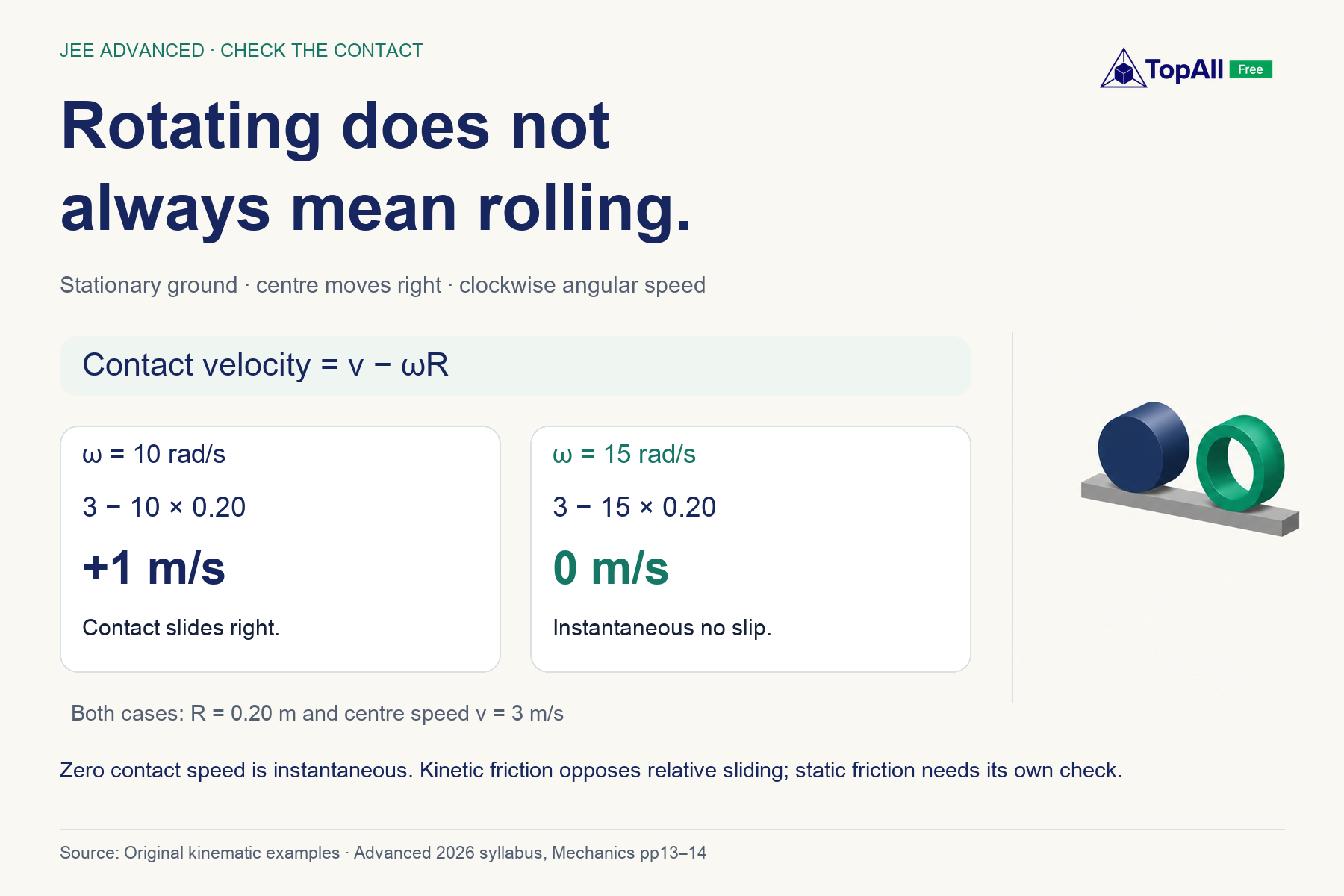
- For the stated right-moving, clockwise case, contact speed is v − ωR.
- Kinetic friction follows relative contact motion; static friction must be solved from the actual situation.
Start here if: Know centre-of-mass velocity, angular velocity, moment of inertia and rigid-body velocity addition.
Jump to a section
A constraint needs a physical reason
For a round rigid body on a stationary straight surface, rolling without slipping means the point in contact has zero instantaneous velocity relative to that surface. Rotation alone does not establish the condition. Check the motion at the contact before using the familiar speed relation.
The 2026 Advanced syllabus explicitly includes no-slip rolling of rings, cylinders and spheres. Our examples are original kinematic and energy calculations. The NCERT rotation chapter supports the rigid-body and inertia prerequisites; it is not presented here as the source of a complete rolling-contact treatment.
Combine the two velocities
Take a cylinder whose centre moves right at speed v and whose angular motion is clockwise with magnitude ω. Its bottom point moves left relative to the centre at speed ωR. With right positive, the bottom point therefore moves at v − ωR relative to stationary ground.
If this is zero, the instantaneous no-slip condition is satisfied. If it is positive, the contact point slides right; if negative, it slides left. Reversing the physical rotation changes the signed velocity addition. Do not apply a magnitude formula without first specifying directions.
Work it through
Check the velocity of the contact point
The centre moves right at v.
The bottom point moves left relative to the centre at ωR.
Contact-point velocity relative to the ground: v − ωR.
On stationary ground, zero means instantaneous no slip. A nonzero result means the contact point is sliding.
Original one-dimensional velocity decomposition. Right is positive, ω is the clockwise magnitude and R is the outer contact radius. It applies to the stated stationary, straight surface. Source and scope.
TopAll · Original teaching example
A moving and rotating cylinder that is slipping
Original worked example. Let the outer radius be 0.20 m, the centre speed 3.0 m/s to the right and angular speed 10 rad/s clockwise. The rotational contribution at the bottom is 10 × 0.20 = 2.0 m/s to the left. The contact point moves at 3.0 − 2.0 = 1.0 m/s to the right relative to the ground.
So the cylinder is slipping at that instant. If kinetic friction is present at this contact, it acts left on the cylinder, opposing that relative sliding. A conclusion about the acceleration or subsequent time to no slip would also need the forces, inertia and friction model; the velocity check alone does not supply them.
When the speed relation becomes legitimate
For the same 0.20 m outer radius and 3.0 m/s centre speed, clockwise angular speed 15 rad/s gives ωR = 3.0 m/s. The instantaneous contact speed is zero. Over an interval of maintained no-slip motion on stationary straight ground with constant R, the compatible tangential accelerations satisfy the corresponding differentiated constraint. A snapshot of equal speeds alone does not prove the body will continue satisfying it.
Do not automatically set friction to its maximum static value. Static friction adjusts within its allowed range and can be zero. Its direction depends on the forces and torques that would otherwise make the contact slip.
Add an independent energy check
An ideal uniform solid cylinder of mass 2.0 kg rolls without slip at 3.0 m/s. Using I = ½mR² about its centre and ω = v/R, its kinetic energy is ½mv² + ½Iω² = ¾mv² = 13.5 J. The translational part alone is 9.0 J. This calculation uses a uniform solid-cylinder inertia, not the inertia of every rolling object.
Keeping the words uniform solid cylinder beside the equation prevents a common substitution error. A thin ring at the same mass and speed has a different rotational contribution.
Try the opposite sliding direction
An original test case has R = 0.10 m, v = 1.0 m/s right and ω = 15 rad/s clockwise. Is the contact sliding, and in which direction would kinetic friction act on the body?
Show the reasoning
The contact-point velocity is 1.0 − 15 × 0.10 = −0.5 m/s: it slides left relative to the stationary ground. If kinetic friction acts, it points right on the body. This does not contradict a right-moving centre; friction opposes relative contact sliding, not necessarily centre motion.
Your next study session
Practise, then review your mistakes
Suggested task: choose 10 available chapter questions, allowing about 20 minutes plus error review. Adjust the pace if you are learning the concept for the first time.
- Choose ten available concept questions; this is a suggested task, not a separately filtered paper.
- For each mistake, record the first incorrect step and a brief correction.
- After a break, test the same idea with a fresh example before moving on.
The TopAll JEE chapter bank builds concept fluency. Use the official archived papers separately to rehearse their full section and marking format.
Open related chapter practice →Sources and method
Official sources establish concept or syllabus scope. Examples, calculations and planning routines are original editorial work, not PYQs, chapter-weightage estimates or performance guarantees.
- JEE Advanced 2026 official syllabus
2026 · PDF pages 13-14: mechanics; pages 1-8 Chemistry; pages 9-12 Mathematics · Checked 2026-10-20
- NCERT Physics: Systems of Particles and Rotational Motion
2026-27 reprint · Rigid-body rotation and moment of inertia; rolling contact examples below are original kinematic derivations · Checked 2026-10-20
Frequently asked questions
Start with your question. Open an answer, then choose one study task to try.
Does rotation guarantee rolling without slipping?
No. Combine the centre and rotational contributions at the contact point. The point must have zero instantaneous velocity relative to the surface for no slip.
Is v = ωR valid on a moving belt?
Not with v interpreted as centre speed relative to stationary ground. The contact velocity must match the belt velocity; define a frame and use the appropriate signed relation.
Is static friction always equal to μsN?
No. That is the maximum available magnitude in the elementary model, not a value to impose in every no-slip problem. Solve for the required static friction, then check the bound.
Does the TopAll chapter link simulate Advanced marking?
No. It offers general JEE concept MCQs. Use official archived papers for section-specific response formats, partial marking and numerical-entry instructions.