
What you will take away
- Name the individual concepts before trying to combine them.
- Write assumptions and intermediate results so one mistake does not hide inside a long solution.
- Check your model with a simpler limiting case.
Start here if: Know translational energy, moment of inertia and basic matrix multiplication.
Jump to a section
Use mixed concepts as a learning task
The official paper archive lets you study the actual problems and section directions. Start a combined problem by identifying each familiar concept, then explain the connection between them.
Sources: JEE Advanced official past papers.
First identify which ideas you already know and which connection is new. If you cannot solve the individual components, practise them before trying a lengthy combined problem. If you can, keep a diagram and a short chain of equations rather than expanding everything immediately.
Work through this example
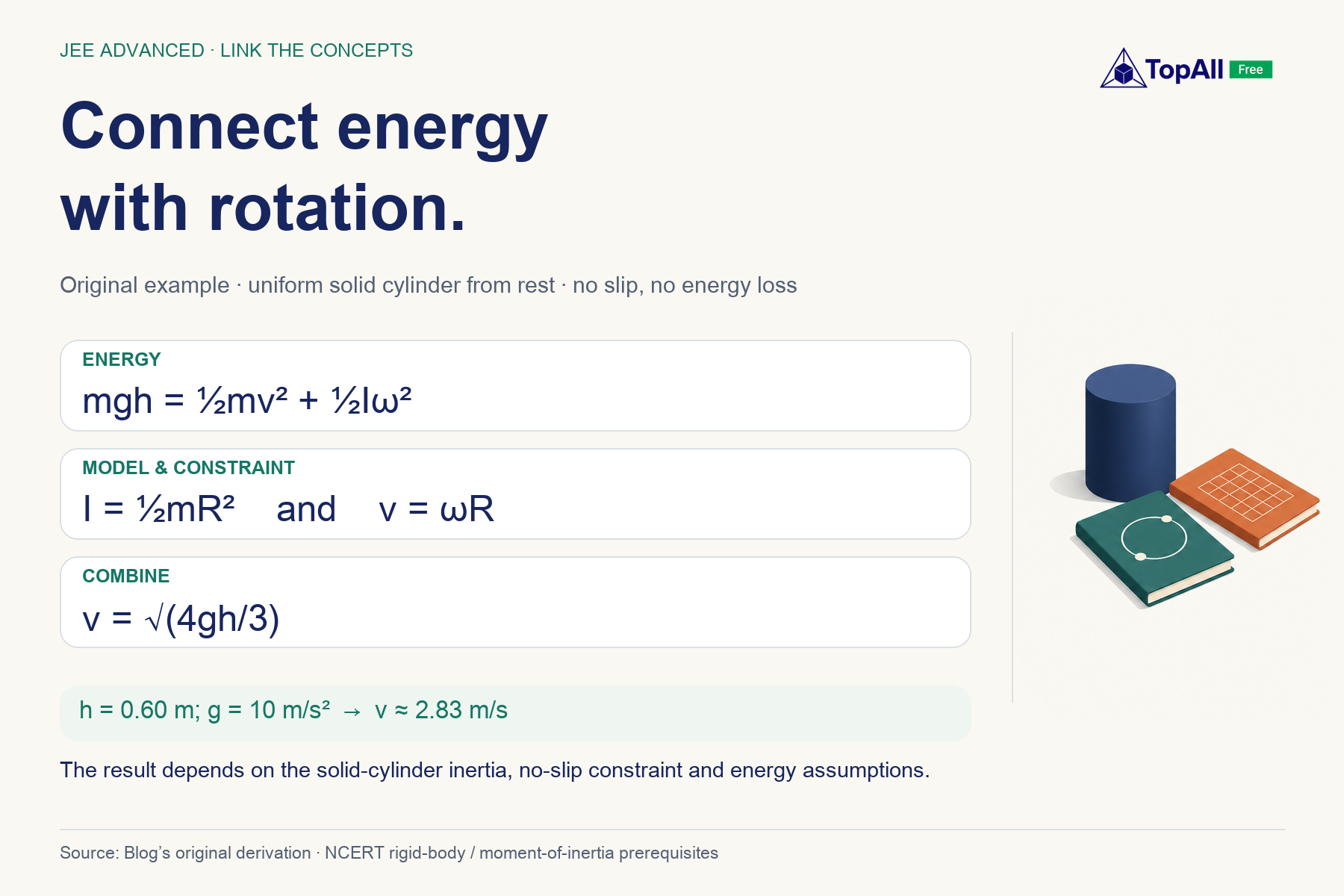
Original teaching example. A uniform solid cylinder rolls from rest through a vertical height h without slipping. Assume no energy losses. Use mgh = ½mv² + ½Iω², with I = ½mR² and v = ωR. Then mgh = ¾mv², giving v = √(4gh/3). For h = 0.60 m and g = 10 m s−2, v = √8 ≈ 2.83 m s−1. The connection is between energy conservation and rotational kinematics.
Check why each step was permitted
The relation v = ωR uses the no-slip condition. The energy equation assumes losses are negligible. The moment of inertia is for the specified solid cylinder, not every rolling object. Replace I with kmR² and the result becomes v² = 2gh/(1 + k). Taking k = 0 recovers the translating point-mass limit, a useful consistency check.
Sources: NCERT official textbook catalogue.
If the object slides or the support moves, revisit the model before reusing the same result. The skill is choosing and defending the model, not remembering one answer for every diagram.
A second connection in Mathematics
Original teaching example. Let A = I + N, where N = [[0, 1], [0, 0]]. Since N² = 0, the binomial expansion gives An = I + nN for positive integer n. For n = 5, A5 = [[1, 5], [0, 1]]. One matrix multiplication reveals the simplifying structure; expanding five full products would hide it.
Now explain why the result would fail for an arbitrary N whose square is not zero. That check connects algebraic structure with the matrix calculation rather than treating a pattern as universal.
Check your understanding
For the rolling example, why is the result slower than √(2gh)?
Show the reasoning
Some of the available energy is rotational kinetic energy. With positive k, v² = 2gh/(1 + k) is below 2gh under the stated assumptions. A faster result would prompt you to recheck the model or algebra.
Your next study session
Practise, then review your mistakes
Suggested task: choose 10 available chapter questions, allowing about 15 minutes plus error review. Adjust the pace if you are learning the concept for the first time.
- Answer ten available questions without notes. This is a suggested task, not a separately filtered ten-question paper.
- For each error, record the concept, the step you missed and a short correction.
- Return to the same concept after a break and explain the correction before trying a new question.
The TopAll JEE chapter bank builds concept fluency. Use the official archived papers separately to rehearse their full section and marking format.
Open chapter practice →Sources and method
Historical examination facts use the cited official documents and exact page locators. Study routines and teaching examples are original editorial suggestions. No question-share percentage or future score, rank or admission guarantee is inferred. Current NCERT reprints support concepts, not historical wording.
- JEE Advanced official past papers
2021–2025 archive · English Paper 1 and Paper 2 links for each year · Checked 2026-10-19
- NCERT official textbook catalogue
Current catalogue · Select Class XI or XII and the named subject/chapter; editions can change · Checked 2026-10-19
Frequently asked questions
Start with your question. Open an answer, then choose one study task to try.
Why is the rolling cylinder slower than a translating point mass?
Under the stated no-slip and no-loss model, some energy becomes rotational kinetic energy. For the solid cylinder this gives v = √(4gh/3), below √(2gh) for the translating point-mass limit.
Can I use v = ωR if the object slips?
That relation was used because the example specifies rolling without slipping. If the object slips or the support moves, revisit the model before reusing the same equations.
Why does (I + N)ⁿ simplify to I + nN in the matrix example?
The specified matrix has N² = 0, so the higher powers vanish in the binomial expansion for positive integer n. That simplification does not hold for an arbitrary matrix N.
Which rolling task should follow this Advanced guide?
Try the companion rolling-versus-slipping lesson in this study path. Determine the contact-point velocity before imposing a no-slip constraint, then check the assumptions behind any energy calculation.